Millions of seafarers worldwide continue to form the backbone of the global economy and yet their apparent invisibility as critical or essential workers remains a major challenge for especially South Africa – a situation lavishly laid bare by the outbreak and spread of the Covid-19 pandemic since about a year ago.
According to KwaZulu-Natal University professor, Shaun Ruggunan more than a quarter of the approximately 4 500 South African seafarers working on ships abroad found themselves stranded at ports across the world after most countries, including South Africa, imposed variable regional lockdowns as part of the fight against the spread of the pandemic.
He was chatting to this blog on Monday this week about the launch of a South African seafarers’ survey last week aimed collecting as much information as is possible about their experiences in the aftermath of the outbreak of the pandemic.
The main purpose of the survey, said Prof Ruggunan, was to understand the impact of Covid-19 on South African seafarers’ mental and physical well-being, with the survey’s findings planned to be shared generally with both maritime sector stakeholders, specifically employers and related, but also with the public.
Other beneficiaries include the South African Maritime Safety Authority (SAMSA) – which has given its full support to the initiatives – other seafarer involved institutions as well as crewing companies.
“The survey will run for a month in order to allow for as many South African seafarers – a majority of The first purpose of the survey is to make seafarers visible by bringing to the public’s attention the role seafarers and the conditions under which they have fared during outbreak of the pandemic, so that people get to understand how important the sector workers are to all of us,” said Prof Ruggunan
He added that in addition to general public awareness, employers will also gain insight from the experience of the country’s seafarers while the survey’s findings may also contribute to necessary policy interventions that are evidence-based.
For the full chat, please click on the video below.
University of KwaZulu-Natal professor Shaun Rugguman talking about the South African seafarers survey launched recently to determine impacts of Covid-19 pandemic outbreak
Meanwhile, the UKZN survey is one of two currently running, the other launched by SAMSA last Friday with a view to determining the training needs of seafarers and seafarer training institutions during this period of the Covid-19 pandemic
The SAMSA survey is the second step of its nature this year following to the announcement recently of a further seafarers’ certificates validity extension given South African seafarers whose time limited qualifications might have expired, in order to renew them.
The SAMSA survey, according to Chief Examiner, Mr Azwimmbavhi Nelwamondo will run until 23 April 2021.
Seafarers keen to participate in both surveys can follow these links below in order access the forms, both which take no more than 10 minutes to fill.
National survey launched on Wednesday to determine both training needs and availability of berths
Pretoria: 16 April 2021
The resumption of formal training of South African seafarers which was and continue to be severely negatively impacted largely by the outbreak of the Covid-19 pandemic since a year ago, is set to go full steam ahead this year, subject to further determination of both training needs as well as berths available.
That is according to the South African Maritime Safety Authority (SAMSA) which on Wednesday launched a national survey targeting South African seafarers across the board including the fishing subsector, training institutions, seafarer recruitment agencies and employers.
The step is the second of its nature this year following to the announcement recently of a further seafarers’ certificates validity extension given South African seafarers whose time limited qualifications might have expired, in order to renew them.
The four months certificate validity extension through to 31 July 2021, was given to the maritime industry in the form of a Marine Notice No.10 of 2021 published on the SAMSA website on 31 March 2021.
The further extension granted was, according to the Marine Notice, in consideration that Certificates of Competency (COC) and/or Certificates of Proficiency (COP) issued in accordance with the International Convention of the Standards of Training, Certification and Watchkeeping for Seafarers, 1978, were generally valid for a period of five (5) years from the date of issue.
However, with the outbreak of the Covid-19 pandemic having disrupted virtually all aspects of life, SAMSA said in consideration of the predicament many seafarers and their employers were finding themselves in, it had decided to again grant an extension until 31 July 2021 to any certificate that might expire during the national lockdown and/or shortly thereafter.
In Pretoria on Wednesday, SAMSA announced the launch of the follow-up survey. SAMSA Chief Examiner, Mr Azwimmbavhi Nelwamondo said it would run until 23 April 2021, with its intention being to gather as much information as possible about the training and associated conditions currently affecting the targeted groups.
Mr Azwimmbavhi Nelwamondo. Chief Examiner: SAMSA
Mr Nelwamondo explained: “Since the pandemic hit South Africa, the government enforced a national lockdown which affected training of seafarers. SAMSA has tried to find the balance between safety of seafarers on all vessels and their safety whilst undergoing training.
“Further to balancing the safety aspects onboard ships and during training, a further balance must be found to ensure continuity of the training which has direct impact on the safety of individuals, ships, property and the marine environment,” he said.
Mr Nelwamondo further indicated that one of the challenges already acknowledged as an impediment to continued training of the country’s seafarers was an apparent scarcity of training berths.
“SAMSA has received information that there are not sufficient training berths for all seafarers with certain sub-sectors of the industry and they were therefore requesting an extension further than the dates set in the Marine Notice.
“With this survey, SAMSA thus wishes to establish, from the training providers – considering the pandemic – the status of availability of training berths ever since training resumed in the second half of 2020.
For his full remarks, click on audio below.
The voice of Mr Azwimmbavhi Nelwamondo explaining broadly the purpose of the seafarers training needs and challenges survey.
The SAMSA survey on South African training of seafarers is the second such seafarer survey currently underway – the other, conducted by University of KwaZulu-Natal and backed by SAMSA focused on the general welfare of seafarers particularly since the outbreak of the Covid-19 pandemic in December 2019.
Once on the page, seafarers, employers, recruitment agencies as well as seafarer training institutions can click on the survey links provided on the page.
With more than 133-million people globally infected by the Covid-19 pandemic and close on 3-million of these having succumbed to the virus as of Wednesday this week, the true full impacts of the virus on human society – a full year after its outbreak in Wuhan, China in late 2019 – have yet to be determined.
This notwithstanding, according to the South African Maritime Safety Authority (SAMSA), the suffering by those already affected has been intense and among the victims already reeling from the impacts of the pandemic are millions of seafarers worldwide, thousands of them being South Africans.
It was for that reason that the agency, under the supervision of the Department of Transport, has thrown its full weight behind a survey undertaken by the University of KwaZulu-Natal (UKZN) to collect information directly from South African seafarers that will assist indicate the nature and extent of the Covid-19 pandemic impacts on them.
The survey led by UKZN Professor Shaun Ruggunan, seeks to; “….investigate the impact of Covid on South African seafarers. This survey specifically focuses on how Covid has impacted South African seafarer’s in terms of their work-life balance and the impact of Covid on their mental, emotional and physical well-being,” says the university in a statement.
Said Prof Ruggunan: “We hope that the survey will allow us to show how important seafarers are to the national and global economy and bring greater attention to their work and challenges during the pandemic. The results will be shared and potentially drive or inform policies of employee well-being for SA seafarers. The survey will benefit both employers, seafarers, agencies and seafarer labour market institutions.”
SAMSA File Photo.
Unregistered seafarers far more at risk of negative Covid-19 pandemic impacts
SAMSA
For SAMSA, the initiative was of critical importance and value in more than one respect with regards the country’s seafarers, according to Mr Sibusiso Rantsoabe. Generally, he says, seafarers can be described as operating virtually under the radar – that is, taking up employment with various companies domestically and globally yet without formal registration, and therefore now currently suffering the impacts of Covid-19 without being noticed for assistance.
“The impact of Covid-19 has been felt worldwide. Seafarers have not been spared. Seafarers have been working throughout, as maritime transport is responsible for carrying 90% of world cargo by volume. It was essential that shipping continued to operate through various lockdown regimes implemented by different countries. This ensured that critical movement of supplies of food, medicine, including medical equipment remained unhindered during lockdown,” says Mr Rantsoabe.
However, several countries across the world inclusive of many that are South Africa’s trading partners in Asia, Western Europe and the American continent embarking on variable states of national lockdown to this day, seafarers struggled and continue to, with millions finding themselves unable to sign off in various ports around the world due to travel restrictions.
“Some seafarers including South Africans found themselves stuck in vessels for much longer periods than they signed for. This led to the situation being termed ‘the humanitarian crisis at seas’,” said Mr Rantsoabe, pointing to the intervention that soon ensued in the global maritime sector led by both the International Maritime Organisation (IMO) the International Labour Organisation (ILO) and other interested and affected parties, calling for seafarers to be declared “key workers”.
With the full backing of the United Nations, the intervention soon succeeded as the IMO, in a Circular letter No.4204/Add.35/Rev.4 issued on 05 February 2021 advised that 55 of its Member States, including South Africa had signed a resolution to declare seafarers “key workers”.
“This has not stopped seafarers suffering due to stringent travel restrictions still in place in various jurisdictions,” said Mr Rantsoabe, adding that because of this very fact, SAMSA – through its welfare section – continues to seek ways to ensure that the country’s seafarers are not left alone to battle with Covid-19 pandemic induced conditions at work.
“Hundreds of South African seafarers found themselves stranded in various parts of the world. SAMSA through its welfare programme managed to assist hundreds of seafarers reach home through various direct and indirect interventions which included advising shipping companies on the processes involved in travelling back to South Africa via repatriation flights and best routes for flying South Africans home. The interventions included direct contact with seafarers, employers of South African seafarers and NPO’s with interest in seafarer welfare.
SAMSA File Photo
“There are still many seafarers that SAMSA could not reach especially cruise staff. Since these seafarers’ occupations do not fall under the SAMSA qualification framework, it was and remains impossible for SAMSA to understand the numbers involved. In addition, cruise staff generally leave the country through recruitment agencies that are not accredited by SAMSA. As such SAMSA is unable to account for them. It is important to note that ‘generally, SAMSA does not get to know when any seafarer leaves the country to take up employment overseas. This has proved to be a major problem as SAMSA struggled to quantify the problem and help required,” he said.
On the UKZN survey, Mr Rantsoabe said: “SAMSA was approached by UKZN for support on the study on impact of covid-19 on seafarer welfare. SAMSA having considered the aim and content of the study fully supports this study. UKZN committed to sharing the results with SAMSA which will provide the Authority with much needed information.
“It is very important that SAMSA gets a full picture of what is/was faced by seafarers during this difficult period. The results will assist SAMSA as we continue to advance the interest of seafarers in various forums within government. The study will also provide information that will help shape the Authority’s welfare offering. All seafarers are encouraged to complete the survey as it will help SAMSA better understand the impact of Covid-19 on seafarers,” said Mr Rantsoabe.
Meanwhile, Prof Ruggunan stated that: “Participation is voluntary, anonymous and confidential and no survey can be traced back to any individual. The survey takes approximately 6 to 7 minutes only and can be accessed on a phone or computer via the link provided (see headline pic above) or by clicking on the photo placed on the landing page of this blog platform, or one placed on the landing page of the SAMSA website.
For further information, alternatively queries; these may be directed to Prof Ruggunan either by email or mobile phone as follows: ruggunans@ukzn.ac.za, cell: 079 1970 743. Also, for all seafarer welfare issues, seafarers both South African and international can correspond with SAMSA through the following email address: welfare@samsa.org.za
However, even with 38 of 49 metric tons of the plastic pellets recovered, monitoring will continue for four more years.
SAMSA
Pretoria: 29 March 2021
With about 38 metric tons of the approximately 49 MT of nurdles that accidentally fell off a cargo ship and into seawaters off the coast of Durban in 2017 now recovered, the three years clean-up operation of approximately 290 kilometres of coastline since launched has officially been brought to an end, the South African Maritime Safety Authority (SAMSA) has announced.
According to SAMSA, the decision to end the three year clean-up operation – taken in consultation with various other interested and involved parties including the Department of Environment, Fisheries and Forestry (DEFF) KZN Department of Economic Development, Tourism and Environmental Affairs (EDTEA), Ezemvelo KZN Wildlife and Transnet National Ports Authority (TNPA) – was made on the basis that the residue of nurdles lately observed through monitoring of affected areas, had become negligible and therefore no longer justified continued recovery.
In addition, crucially, the high- and low-density polyethylene pellets were not only found to be non-hazardous, but it had also been established that they had not caused any known or reported damage or harm either to the ecology of the heavily affected area nor to living mammals both inland and at sea.
The start of the nurdles clean-up on the Durban beachfront in October 2018. (SAMSA File Photos)
However, according to SAMSA, monitoring of the South African coastline along the KwaZulu-Natal province will continue for four more years and in the event of a resurfacing of enough quantities of the plastic nurdles, if necessary, another recovery operation will be instituted.
The formal official cessation of the clean-up operation, according to SAMSA – the coordinator of the operation – comes after more than 160 bags of the nurdles, measuring some 38.8MT in weight, were successfully recovered over the three-year period since the accidental spillage occurred in the second half of 2017.
The spillage into sea of the millions of small nurdles in 25-kilogram bags drew domestic and global attention after they were ripped off their transportation containers into the Durban harbour during a massive wind that wreaked havoc on ships in the Durban harbour on 10 October 2017.
Two of the lost containers, off the MSC Susana vessel, were loaded with the nurdles cargo. The nurdles involved, regarded as non-biodegradable, were described as small plastic pellets of about five (5) millimetres in diameter, with a flotation density of 0.91-0.97 grams per cubic centimetre (g/cmᵌ).
Shortly after the incident, SAMSA together with the DEFF, the KwaZulu-Natal Economic Development, Tourism and Environmental Affairs (EDTEA), Transnet, environmental groups including Ezemvelo KZN Wildlife, vessel owners, MSC, London based International Tanker Owners Pollution Federation Ltd (ITOPF), salvage and emergency group, Resolve Marine; as well as various other parties, launched an extensive and intensive recovery project of the plastic nurdles all along the KwaZulu-Natal coastline, but with specific focus on a 290km area of the coast where the pellets found concentration.
The aim of the clean-up operation according to SAMSA, was three-fold (a) to reduce impact on human life, (b) to recover the pellets as quickly as possible (c) and to minimize impact on the environment.
The clean-up operation reliant partly on a scientific modelling to hopefully accurately predict movement of the pellets, would therefore essentially also involve an inspection of almost the entire South African oceans coastline, from Richards Bay through to the Western Cape.
According to SAMSA, the coastline inspection found evidence of nurdles presence in some of the areas, particularly in the Western Cape and some areas of the Eastern Cape. However, the nurdles found here were established to have come mainly from industrial waste discharges rather that from the Durban port ship incident in question. In other areas such as Port St Johns on the Wild Coast, concentrations were very low.
SAMSA says that with concerns also related to ocean currents movements along the Indian Ocean, the pellets might end up polluting the seas along other countries as far as Australia, enquiries were made. But these elicited no clear evidence of such widespread dispersion or leakage over the last three years.
Instead, after both aerial and land inspections, the greatest concentration of the nurdles deposition was found to have occurred largely just north of the Durban port city in an area of coastal high dune concentrations, inshore reefs and beaches as well as river mouths incorporating Addington, Port Dunford, Dokodweni, the Tugela River through to uMhlathuze towards Richards Bay.
SAMSA said final reports of monitoring and recovery by some of its participating partners, the DEFF, the KZZ EDTEA and ITOPF late last year, indicated that “the affected areas have received relatively low levels of recharge of SABIC plastic nurdles and, applying the ‘law of diminishing returns’, all recovery operations on all affected areas to be ceased.”
SAMSA and its partners in the operation would continue to “keep an ear and eye on the ground” for any possibility of nurdles resurfacing, and where deemed necessary, action will be taken to recover them.
Asked what has been done with the recovered 38,8MT of nurdles; SAMSA said these were recycled and used to make park benches dedicated to the late Ms Caroline Reid formerly a secretary of KwaZulu-Natal’s Marine Waste Network. Ms Reid reportedly passed away in July 2018 after being involved a vehicle accident in Durban. She was 41 years old at the time.
Captain Nicholas Stone. Director: Marine Resolve Group
Meanwhile, it has emerged that following to the Durban port nurdles spillage incident, the South African government through the Department of Transport, SAMSA and DEFF is being urged by shipping transport industry players to support a call on the International Maritime Organisation (IMO) to review shipping containers stowage such as that of plastic nurdles, and where possible, require that such cargo be relocated to the underdeck of cargo spaces of ships.
Parties to the call in South Africa include Resolve Marine whose executive, Mr Nicholas Sloane confirmed his company’s approach to the IMO about the matter.
According to Mr Sloane, prevention of loss at sea of material such as nurdles from ship’s cargo due to sea conditions and related accidents can be achieved with proper, purposeful stowage aboard vessels. This, he says, is necessary also because generally, seafarers manning cargo vessels are not always aware of contents of containers being transhipped.
“With over 3 000 containers lost in the oceans every so often, nurdles are the worst cargo to be lost.” says Mr Sloane.
The Cape Acacia, Vuka Marine’s latest addition to the South African Ship Register berthed at the port of Saldanha on Saturday, 20 March 2021 for its cargo shipment of iron ore to Asia.
Saldanha Bay: 24 March 2021
The South African government’s ambitious plans to facilitate for and nurture the redevelopment of a domestically registered national fleet of trade vessels, as outlined in the Comprehensive Maritime Transport Policy (CMTP), has the full backing of the private sector, with actual money on the table.
This was again amply expressed as well as demonstrated during the past weekend when one of the country’s trade ships owning company, Vuka Marine, added one more cargo ship – the largest of its class – to the South African Ship Register, this with the full backing of its mining client, Anglo American.
Visuals of the ceremonial flagging of the Vuka Marine owned cargo vessel, the Cape Acacia under the South African ship register at Saldanha Bay, Northern Cape on Saturday, 20 March 2021. The vessel is the 4th to be added to the country’s register by Vuka Marine since August 2015.
Saldanha Bay, the country’s main port for iron ore exports, was the venue on Saturday (20 March 2021) for the ceremonial hosting of the South African flag aboard stern of the newly acquired Vuka Marine ship, named the Cape Acacia. The vessel, a 206,000dwt Newcastlemax, built in 2005, was the 4th by Vuka Marine to be registered under the South Africa flag, bringing into the country’s ship register a cumulative deadweight capacity of 630 000 tonnes since 2015.
It was at the same port venue on the west coast of the Northern Cape Province in 2015 that Vuka Marine also formaly introduced its first ship that year, the Cape Orchid – now retired – and in the process, helping reintroduce large cargo vessels under the South African ship register since the collapse of a domestic fleet of such vessels type in the late 80’s.
All four of the Vuka Marine vessels – including the Cape Enterprise; and the ultramax Windsor Adventure – have Port Elizabeth (a.k.a Gqeberha) in the Eastern Cape Province as their home port – a matter itself described as having a particular significance for that region as well as the country.
At the port of Saldanha on Saturday, where the newly registered Cape Acacia berthed for its first load of iron ore export shipment to China, Vuka Marine senior officials, flanked by their Anglo American counterparts, representatives of the Department of Transport (DoT), the South African Maritime Safety Authority (SAMSA) and Transnet National Ports Authority (TNPA), spelt out their investment vision.
Mr Andrew Millard. Director: Vuka Marine
“We view ships as a catalyst for a broader social impact (particularly job creation) and advancement of national interests – priorities that lie at the heart of National Policy. To this end, Via Maritime Holdings, majority shareholder of VUKA Marine, has been proactive in creating seafarer sourcing channels that apply international standards, best employment practices and are consistent with demand-side requirements. This is work in progress, but we are starting to see successes in the careers of young South Africans who have worked on Vuka Marine ships,” said Mr Andrew Millard, CEO of Vuka Marine.
Vuka Marine, said Mr Millard, was proud to have pioneered the domestication of cargo ships in the country and that his organisation was keen to share its own experiences with the rest of the sector.
Mr Andrew Mthembu. Chairman: Vuka Marine
The theme was further broken down into minute detail by the shipping company’s chairman, Mr Andrew Mthembu. In a 25 minute speech (captured in the video below), Mr Mthembu described it simply as “logical in every concievable way” that South Africa should strive to rebuild its own fleet of trade vessels if its geographical positioning as a maritime country is to be of benefit to all citizens as well as the global community.
For his full views, click on the video below.
Mr Pranill Ramchander, Executive Head of Corporate Affairs at Anglo American concurred with the Vuka Marine officials on the express need for supporting the South African economy through direct investment in shipping and associated infrastructure. Anglo, he said, had over the years demonstrated its commitment to the country and the partnership with Vuka Marine, through business support, was a typical example of such attitude and goal.
Mr Pranill Ramchander. Executive Head: Corporate Affairs, Anglo American
He said: “We highy comment Vuka Marine’s persistance and tenacity in developing and growing the maritime landscape in South Africa over the last few years. Anglo American is very proud to have been part of the journey which for us started in 2014. During that time Anglo transported approximately 15-milllons tons of cargo and contracts, most of it iron ore.
“Vuka Marine deserves credit from all in this room for taking a leading role in championing the agenda for growth of the South African maritime economy,” he said, adding that a strong and effective shipping infrastructure in South Africa would be an asset to a whole range of stakeholders, including job creation and skills development.
For his full remarks, click on the video below
South Africa’s Transport Minister, Mr Fikile Mbalula, billed to also grace the event but withdrawing at the last moment due to other pressing commitments, had his ministry’s views shared. In remarks shared on his behalf by DoT Marine branch deputy Director-General, Mr Mthunzi Madiya, he said: “Today is one of the most significant days for Maritime South Africa. When we developed this term, we envisaged a unifying entity that incorporates government and industry, enjoining them through their common interest in the success of the maritime sector. For us this means jobs, employment, influence and meaningful contribution to the economy.
Mr Mthunzi Madiya, Deputy Director-General: Marine Branch, Department of Transport
“I am sure Vuka Marine has similar indicators, perhaps an added few that nay includes profits. Equally Anglo would have their own scorecard that is well served by today’s event if not milestone.”
Mr Madiya said the redevelopment of the country’s shipping fleet was a critical building block to enabling South Africa achieve its goals of becoming a significant international maritime centre, characterised chiefly by an effective maritime sector administration able to facilitate economic growth of the industry.
“We are enjoined into ensuring a South African maritime sector that supports South Africa’s economic development. We have a stated objective, as contained in our Maritime Transport policy, that South Africa WILL be an International Maritime Centre. We have defined the characteristics of this International Maritime Centre as only two elements, a vibrant maritime economy that is supported by a model maritime administration,”he said.
To this end, he announced plans for further continued close engagement with the shipping industry for discussions on a range of issues including enhancement of investments incentives, contribution to greenhouse gas emissions control, skills development and training and related. Further details on the various subsector engagements would be shared with stakeholders soon, he said.
For the full remarks, click on the video below.
For SAMSA, the country’s agency responsible for promoting growth of the local ship register in accordance with its legislated broad mandate to, among other things, ‘promote South Africa’s maritime interests’; the additional cargo vessel into the country’s ship register was a welcome work in progress – occurring amid a whole range of challenges facing both the local and global economies, now compounded by the outbreak and rapid spread of the Covid-19 pandemic.
Ms Nthato Minyuku. Chairperson: SAMSA Board and Ms Tsepiso Taoana-Mashiloane. Acting CEO: SAMSA
Now with a team of female leaders for the first time since establishment 21 years ago – Board chairperson, Ms Nthato V. Minyuku, and newly appointed acting Chief Executive Officer, Ms Tsepiso Taoana Mashiloane; SAMSA described the private sector’s efforts – as demonstrated by both Vuka Marine and Anglo American as both humbling, commendable and encouraging under current global economic and consequent social crisis, particularly with regards jobs creation.
Among other issues, SAMSA noted as particularly highly significant that Vuka Marine, with its further acquisition of another cargo vessel, made a point of ensuring places for skills development of South African seafarers. With its inaugural iron ore cargo shipment out of South Africa this week, the Cape Acacia is taking with eight (8) cadets for skills development in seafaring over a period of between 6-9 months.
The cadets on board including one 3rd Officer; two able seamen, one deck and two engine cadets as well as two ABs are Loyiso Jantjies, Jethro Kekai, Ludfie Kemp, Sibusiso Khawula, Siphesihle Sibaya, Lunga Dlamini, Aside Shaun Maqubela and Nduduzo Mahaye. According to Vuka Marine, they may be joined by a further two South African seafarers, probably in Asia.
For SAMSA, redeveloping a South African fleet of cargo vessels was necessary partly to address the challenges facing seafarer education and training.
For both Ms Taoana-Mashiloane and Ms Minyuku’s full remarks, click on the videos below.
In the midst of challenging conditions at the port of Saldanha including restrictions related to Covid-19 regulations and compouded by poor weather conditions, this blog sought and managed to secure interviews with at least two of the eight (8) cadets taken on board the Cape Acacia for stints of between 6-9 months honing their seafarers skills.
The two, Loyiso Sydney Jantjies, an Able Seaman; and Lunga Dlamini, a deck cadet; were beyond themselves with joy at the opportunity to sail and gain valuable skills in their chosen careers in the process.
The outbreak of the Covid-19 pandemic worldwide – and in its wake, the devastation both of economies as well as social development as the world knew it until December 2019 – should not be used as another excuse to dampen or delay the critical advancement of women both in the workplace as well as in society generally.
According to the South African Maritime Safety Authority (SAMSA) in Pretoria this week, this is particularly true of especially the maritime economic sector globally and domestically – a sector in which only about two (2) percent of the global workforce is constituted by women.
The viewpoint surfaced strongly on International Women’s Day as the State agency under the Department of Transport, joined the global community for the first time in marking the event on Monday, 08 March 2021.
Leading the charge was newly appointed SAMSA acting Chief Executive Officer, Ms Tsepiso Taoana-Mashiloane on a secondment basis until month-end or such other time as a new CEO is appointed. Significantly, on her secondment recently from the Department of Transport, Ms Taoana-Mashiloane became the first woman ever appointed to lead SAMSA in its 21 years of existence.
Noteworthy also, SAMSA’s new Board of Directors appointed in 2020 is also chaired by a woman, Ms Nthato Minyuku.
This year’s IWD21 theme was #ChooseToChallenge and its overall message stated: “A challenged world is an alert world and from challenge comes change. So let’s all choose to challenge. How will you help forge a gender equal world?”
Celebrate women’s achievement.
Raise awareness against bias.
Take action for equality.
In SAMSA’s inaugural marking of International Women’s Day 2021 this week at her urging, Ms Taoana-Mashiloane along with three of her colleagues; Captain Pretty Molefe, a principal officer for SAMSA’s Richards Bay office, Captain Antoinette Keller, also a principal officer for SAMSA Cape Town office, and Ms Zamachonco Chonco-Tladi, a chief financial officer for SAMSA since late last year, set aside time to reflect on the significance of the event on Monday to themselves personally and collectively as women both at SAMSA, as well as the general maritime economic sector in South Africa and globally.
Summarily, in the 20-minute video below, Ms Taoana-Mashiloane says while her recent appointment to lead temporarily the organisation is highly significant for women advancement generally, she is currently simply not impressed either by SAMSA or the country that women advancement and empowerment through gender equity centred policies and practices is being taken as seriously and meaningfully as it should, and for this, she says, there is absolutely no excuse.
Twenty-seven years since the dawn of democracy in South Africa and against the backdrop of a plethora of legislative reforms inclusive of a National Policy Framework for Women’s Empowerment and Gender Equality, women advancement through gender equity still lags very much behind, she says.
As for the maritime sector and role-players therein including SAMSA, she says; South Africa as a Member State of the International Maritime Organisation (IMO) and related institutions, has a vast wealth of support to draw from in efforts towards purposeful women advancement.
Ms Tsepiso Taoana-Mashiloane. Acting CEO: SAMSA
It is a strongly held view she first shared with SAMSA staff in an internal memo on Monday, wherein she stated: ““I join the IWD 2021 #ChooseToChallenge by expressing my sentiments as a woman in maritime transport. I am an empowered woman and I strive to always empower other women.
“We are SAMSAítes women and we are changing to rise to the challenge by celebrating all women in maritime/shipping. The gender split in SAMSA Executive level stills shows an organization stuck to the old saying that this is a ‘man’s world’.
“Women Can! And with the right skills set, education and empowerment, now is the time for SAMSA to embrace gender diversity, harness our energy and creativity to make a contribution to SDG#5 Gender Equality,” said Ms Taoana-Mashiloane.
In the video, Ms Taoana-Mashiloane strongly suggests that women, in fact, should be in the leadership of women advancement themselves.
In marking IWD21 internally, SAMSA developed a set of posters featuring some of the agency’s women. In addition, video interviews were arranged for some of the employees in order for them to also freely express their views on the subject. Two of these additional video interviews are shared below, here along with Ms Taoana-Mashiloane’s.
Crucially, the two SAMSA female employees interviewed, Captain Keller and Ms Chonco-Tladi – both holding senior ranking positions at SAMSA in administration and operations, shared much in common with the agency’s acting chief executive officer.
I don’t like to be placed in “a box”. I don’t like stereotyping, for example; the stereotype of women as the carer. Through hard work and determination women are just as capable as men to excel in the workplace.
Captain Antoinette Keller. Master Mariner and Principal Officer at South African Maritime Safety Authority (SAMSA)
Both Captain Keller and Ms Chonco-Tladi felt there was far more expressed intent – alternatively, “too much chit-chat about it’- than actual meaningful action in advancing women within both at SAMSA and the country in general.
Captain Antoinette Keller. Principal Officer: SAMSA (Cape Town)
In the video below, Captain Keller – South Africa’s first female Master Mariner as well as the first female Principal Officer for SAMSA – states: “It was through hard work and determination that I was able to work through the ranks and I believe that I opened the door for many other women pursuing a maritime career.”
Captain Keller, also the 2020 SAMSA’s CEO Excellence Award overall winner in recognition of her work contribution beyond the call of duty, states; “I do support gender equity strategies. However, I think it is sad that strategies such as these are required to be established in the first place. I don’t like to be placed in “a box”. I don’t like stereotyping, for example; the stereotype of women as the carer. Through hard work and determination women are just as capable as men to excel in the workplace.
“South Africa is a diverse nation and we should embrace the diversity by allowing fresh and dynamic perspectives based on who is most capable for the job. I do support gender equity. However, the tools must be given to allow success. There should be confidence in the person fulfilling the role otherwise it can open ways for one to be undermined in the workplace.
“Both genders bring strengths to the table. In the maritime industry, it is not that women are not given opportunities, however there is scope for a lot more that can be done. More focus and awareness should be placed on possible career opportunities in the maritime sector and we need a big behavioural change. Not many people are aware of what the maritime industry can offer or who SAMSA is and the role we play in the maritime sector,” says Capt. Keller.
For more on this, click on the video below.
Ms Zamachonco Chonco-Tladi. Chief Financial Officer: SAMSA
Meanwhile, Ms Chonco-Tladi, a Chartered Accountant with a relatively long professional service history, yet virtually a beginner in the maritime sector after having joined SAMSA in the second half of 2020, concurred with both views that the subject of women advancement was getting tired for being talked about for years, with little action to advance it; but also pregnant with opportunity for all members of society to work together to bring about transformation and justice for women.
She said she was among those prepared to roll up their sleeves and get into action for women empowerment and advancement. A mentor of note, quite keen to readily share her knowledge and experience, Ms Chonco-Tladi said more awareness through focused campaigns was crucial. Click on the video for her full views.
In Richards Bay, Captain Pretty Molefe, yet another pioneer in her own right for also being among the first batch of black females to qualify as Master Mariners in South Africa, as well as being the first black female Principal Officer, in acting capacity for SAMSA, shared her views in writing this week.
People always expect men in certain positions and often get surprised when a female pitch up. In general, it is a job that is predominantly perceived as a male job and one has to work extra hard than a male counterpart
Captain Pretty Molefe. Acting Principal Officer at SAMSA (Richards Bay)
She also remarked on the significance of marking IWD21 relative to the poor and painfully slow progress being made in the country and precisely the maritime sector towards women advancement through gender equity centred policies, several of which have long been in existence in a variety of forms.
Captain Pretty Molefe. Acting Principal Officer: SAMSA (Richards Bay)
“I generally love what I do. The ship and shore aspect of it. I like being part of a team and learning new things all the time. Unfortunately, or fortunately, I have only had male mentors in my career path as there are not many females that come before me. Some of those that came before me, I, unfortunately have had to admire from a distance; but one or two have made an indirect impact in my career path.”
“Many people often ask about challenges that one has faced in this career as a female. There are a lot, both at sea and on the shore side. People always expect men in certain positions and often get surprised when a female pitch up. In general, it is a job that is predominantly perceived as a male job and one has to work extra hard than a male counterpart,” says Captain Molefe.
According to Ms Taoana Mashiloane, SAMSA will continue to be among progressive State organisations to scale up efforts towards meaningful women advancement in the country’s maritime sector, at least if she has anything to do with it. She lists a set of initiatives she envisages should receive priority towards this end, among which is the formal re launch of a women in maritime structure whose rebirth last year was hampered by the onset of the Covid-19 pandemic.
Awareness campaigns conducted jointly with other organisations in the sector, including the South African International Maritime Institute (SAIMI), Transnet and others are also in the planning, she sad.
By this time next year, said Ms Taoana-Mashiloane, there should be a comprehensive report in place reflecting on progress being made towards women advancement in the country’s maritime economic sector
Postponed a year ago due to the outbreak of the Covid-19 pandemic and associated lockdown rules promoting social distancing worldwide, an Africa region maritime sector plan of action aimed at contributing to global measures to mitigate against climate change gets underway again this month in the form of an Energy Efficiency Conference and Exhibition (ConfEx) over four days.
The ConfEx – originally scheduled for Durban, South Africa in June last year, before being scrapped – is being organised by the Mombasa, Kenya-based Maritime Technology Cooperation Centre (MTCC-Africa), and this time, it will be held virtually online, announced the South African Maritime Safety Authority (SAMSA) in Pretoria at the weekend.
The MTCC-Africa, is an International Maritime Organization (IMO) and European Commission funded initiative known as the Global MTCCs Network (GMN), with centres also in Asia, the Caribbean, Latin America and Pacific regions. Initially funded to the tune of €10 000 000 over four years in 2017, it is geared towards building capacity in the targeted regions for climate mitigation in the world’s maritime shipping industry.
The ConfEx to be held over four days in two successive weeks this month, the first on 17&18 March 2021 and thereafter on 24&25 March 2021 will be staged within context of the IMO MARPOL Annex VI that is concerned with the prevention of air pollution by ships.
The IMO MARPOL Annex VI advances implementation of global regulations to address the emission of air pollutants from ships and the mandatory energy efficiency measures aimed at reducing emission of greenhouse gases from international shipping thereby ensuring that shipping is cleaner and greener.
Representatives of 13 African countries involved with the IMO Global MTCC Network gathered at the first meeting of the MTCC-Africa branch in Mombasa in December 2017. (Photo: Courtesy of Global MTCC Network)
South Africa, an IMO Member State and signatory to the MARPOL Annex VI, is a designated Southern African Region Focal Point of the MTCC-Africa, wherein it is expected to support the agency in promoting technologies and operations aimed at improving energy efficiency in the maritime sector. The Southern African Region consists of Mozambique, Namibia, Angola, Zambia, Zimbabwe and Malawi.
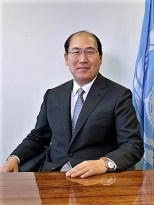
Mr Kitach Lim. Secretary General. International Maritime Organisation (IMO)
A draft programme of the MTCC-Africa ConfEx event shows IMO Secretary General, Mr Kitack Lim and Dr Nancy Karigithu, Principal Secretary of Kenya’s State Department for Maritime Shipping Affairs as being among a host of high level officials scheduled to grace the occasion.
According to SAMSA at the weekend, in addition to experts and related in the field of climate change in the maritime sector, the MTCC-Africa online ConEx will focus also strongly on developers of energy efficient technologies for the maritime industry who will be provided a platform to exhibit their wares.
“The ConfEx is targeting the Small and Medium-Term Entrepreneurs with innovations focusing on climate change mitigation in the onshore and offshore shipping and maritime industry. The objective is to provide a highly interactive knowledge sharing and business networking platform, with the aim of connecting like-minded individuals and innovative solution providers from around the world. In addition to this, technological challenges and opportunities in climate action within the international maritime sector will be addressed. The exhibitors can showcase their market ready technologies and innovations,” said SAMSA.
However, because of social distancing regulations in compliance with Covid-19 mitigation measures, keen participants in both the main conference as well as exhibitors would have to book early online in order to claim their space at the ConfEx, said SAMSA.
Of the actual conference, said SAMSA: “With climate change affecting all of us, it makes sense to always encourage more people to participate in such events, for various purposes, educationally, economically and otherwise. It is against this background, that this event is open to all interested parties, to learn and or contribute in climate change mitigation and shipping’s transition to decarbonisation.”
For exhibitors: “The Confex will provide a highly interactive knowledge sharing and business networking platform with an aim of connecting like-minded individuals and innovative solution providers from around the world. In addition to this, technological challenges and opportunities in climate action within the international maritime sector will be addressed. The exhibitors can showcase their market ready technologies and innovations,” said SAMSA
SAMSA further states that this was an ideal opportunity for particularly South African and southern African countries’ entrepreneurs to expand their market reach both in Africa and globally. “Under the UNFCCC Paris Climate Conference, member countries agreed to limit global warming to below two (2) degrees Celsius. Shipping under the guidance of the IMO, must play a role in reducing its contribution to the global emissions. Developing countries, which play a significant role in international shipping, often lack the means to improve energy efficiency in their shipping sectors.
“Through technical assistance and capacity building, the MTCC project is there to enable developing countries, especially Least Developed Countries and Small Island Developing to effectively implement ship energy-efficiency and emissions reduction measures, thereby ssupporting the United Nations Sustainable Development Goals (SDGs).
“South Africa is fully behind MTCC-Africa to ensure that it can deliver on its objectives that include; improving regional compliance with existing and future international regulations on energy efficiency for ships; promoting the uptake of low-carbon technologies and operations; and raising awareness on the need to reduce Greenhouse Gas and other emissions from the maritime transport sector
“We urge South Africans and Southern Africans, especially entrepreneurs and innovators to take the opportunity presented by the MTCC- Africa and the IMO, of engaging with global counterparts in the development and promotion of energy efficient technologies that can be used by the shipping industry in transitioning to the decarbonised future. It is also an opportunity for many, to learn about the work that the IMO has continually put in place to deliver on the strategic direction entitled “Respond to Climate Change“, as adopted by the IMO Assembly, during its 30th session in December 2017,” said SAMSA
The South African Maritime Safety (SAMSA) has announced the secondment of Department of Transport director, Ms Tsepiso Taoana-Mashiloane, as acting Chief Executive Officer of the agency, with immediate effect.
SAMSA said Ms Taoana-Mashiloane would be replacing Mr Sobantu Tilayi, SAMSA’s Chief Operations Officer, who had acted in the position since 2016.
“Her secondment to lead SAMSA is a transitional arrangement pending the finalisation of the recruitment and appointment process of a permanent CEO,” said SAMSA in the statement in Pretoria on Friday.
Ms Tsepiso Taoana-Mashiloane. Seconded by Department of Transport to Acting CEO of South African Maritime Safety Authority (SAMSA)
The secondment – to be followed soon by a formal appointment of a permanent CEO – according to SAMSA’s Board of Directors, is part of a broader renewed effort currently to stabilise the agency, as well as strenghten its strategic role in the redevelopment and expansion of South Africa maritime economic sector as envisaged in its legislated mandate.
The statement described Ms Taoano-Mashiloane as the Department of Transport’s director for Maritime Industry Development and therefore a long serving and experienced civil servant with broad familiarity with the operations of SAMSA
Her academic qualifications include a Masters of Science degree in Botany & Environmental Management) and an MA in Maritime Safety & Environmental Administration.
“Ms Taoana-Mashiloane is also no stranger to SAMSA as, relative to her position at the Department of Transport, she is well acquainted with SAMSA having worked closely with its management for many years on key programmes; among these the International Maritime Organisation (IMO) periodic audits, the World Maritime Day parallel events – the next scheduled for South Africa this current year – the SA national Inland Water Strategy and the National Ports Consultative Committee.”
The announcement on Friday comes a couple of days after SAMSA held its annual “pre-State of the Nation Address (SONA)” Stakeholders Event staged virtually online on Wednesday evening, involving a number of key maritime sector stakeholders from across the country.
Among these were Mr Andrew Pike, head of Ports, Transport and Logistics at Bowmans, Ms Joey Mulaudzi, CEO of Ports Regulator South Africa, Mr Andrew Millard, director at Vuka Marine, Mr Ross Volk, MD of MSC Cruises SA, Mr Peter Besnard, CEO of SAASOA, Ms Sefale Montsi, Chairperson of AMD, Mr Mthozami Xiphu, Board Chairperson at SAOGA, Mr Odwa Mtati, CEO of SAIMI, Mr Loyiso Phantshwa, Chairman at Fish SA, Mr Kevin Watson, President of SAIMENA, Mr Paul Maclons, CEO of AMSOL, Mr Mthunzi Madiya, and Ms Taoana-Mshiloane on behalf of the Department of Transport.
Ms Nthato V. Minyuku. Cairperson: SAMSA Board of Directors
In her address, SAMSA Board of Directors chairperson Ms Nthato Minyuku described the issue of SAMSA management leadership as among critical issues requiring attention as a matter of priority needed to ensure stability in the agency.
She said: “You would have seen that we are in the market looking for a permanent CEO for SAMSA. This is the first item we have to deliver on. Five years is a long time without a permanent CEO. I would wish to thank the EXCO team that has held SAMSA steady during this period.”
The second aspect to stabilising SAMSA related to its financial position. According to Ms Minyuku, various operational issues now compounded by the outbreak of the Covid-19 pandemic in December 2019, had hugely impacted negatively SAMSA’s finances. She said SAMSA was not about to go to the Treasury with a begging bowl, but the situation needed arresting. Part of this was a proposed five (5) per cent tarrif increase over and above that granted during the last financial year.
An address of SAMSA Annual Stakeholders Event by the agency’s Board of Directors chairperson, Ms Nthato Minyuku on Wednesday evening. The event held virtually online this year is staged annually the evening before South Africa’s official opening of Parliament and delivery of a State of the Nation Address (SONA) by the country president.
“In terms of SAMSA resources, we have been hit hard by the COVID pandemic. At some stage, we were contemplating what we have come to refer to as “cash flow day zero”. Although we have successfully evaded this day, we are by no means clear, much less financially sustainable.
“We are fortunate never having had to go to National Treasury to ask for a “bail out” and I must commend EXCO for this achievement. However, in order to keep sustainable, we have had to request an additional 5% tariff increase to the 6% that was already approved by the Minister with the concurrence of Treasury,” said Ms Minyuku.
Regarding the external environment, she said it was SAMSA’s view that the agency’s strategy was fit for purpose. “It is our view that first and foremost, SAMSA must discharge its regulatory obligations and build capacity to sustain our abilities in this regard. We have adopted a model of delivering on our objective of “promoting the republic’s maritime interests” via partnerships.
“These are partnerships that have seen us create hundreds of jobs for rural youths. These are the partnerships that have seen us starting what will be a long and steady growth of our ship register. We continue along this trajectory, to ensure that we use the synergies that exist between you, the industry and us, the government; as well as the various abilities and instruments among the government players.”
On her reflections broadly onto the country and global maritime sector, Ms Minyuku said South Africa was still relatively well positioned geographically to continue to play a meaningful role in the sector, but that the country needed to step up its effort to both cement its strategic role as well as ensure broader society beneficiation.
She pointed to the coming into effect last month of the Africa Continental Free Trade Area agreement and the vast business opportunities it presents to South Africa particularly from a shipping transport perspective.
The African Continental Free Trade Area (AfCFTA) agreement is poised as likely to …”create the largest free trade area in the world measured by the number of countries participating,’ says the World Bank.
Further, it says: “The pact connects 1.3 billion people across 55 countries with a combined gross domestic product (GDP) valued at US$3.4 trillion. It has the potential to lift 30 million people out of extreme poverty, but achieving its full potential will depend on putting in place significant policy reforms and trade facilitation measures.”
In this regard, Ms Minyuku, South Africa needed to up its maritime sector development efforts towards especially establishment of, among things, a locally registered and South Africa flag carring fleet of vessels.
Ms Minyuku further applauded South Africa’s endorsement of an International Maritime Organisation (IMO) resolution that declares seafarers as essential workers.
For her full remarks on these and related issues, Click on the video above.
More coverage of the SAMSA Stakeholders Event, inclusive of contributions by industry players, will follow.
The South African Maritime Safety Authority (SAMSA says problems encountered by South African seafarers at Department of Home Affairs relating directly to renewal of their expired or expiring passports are being attended to and hopefully soon, these will be resolved.
The SAMSA statement in Pretoria on Thursday comes in the form of a Marine Notice 2 of 2021. The notice comes barely a week after the International Maritime Organisation (IMO), of which South Africa is a Member State, confirmed the country’s ratification of a resolution involving 50 other Member States, granting seafarers globally the status of ‘essential workers’.
In the notice, SAMSA acknowledges that with the outbreak of the Covid-19 pandemic and numerous problems arising since about a year ago, some due to Government’s counter-measures against the spread of the virus, such as the national lockdown at different levels since March 2020, seafarers but especially South African seafarers, have been among workforces who have suffered most even as the maritime sector remained operational for the longest of time under the circumstances to date.
In the notice, SAMSA in further acknowledgment of the effort put up by the South African government through various departments inclusive of the Department of Transport under which shipping transport falls, states nevertheless that: “….as much as Maritime Transport remained essential in the eyes of the world’s authorities as it continued to be allowed to operate under different lockdown regimes around the world, seafarers were forgotten. Crew changes were banned in many countries during the first half of 2020.
“This caused mayhem in the maritime industry as seafarers struggled to sign-off vessels and relievers struggled to get to ships. This resulted in what some termed as the humanitarian crisis at sea as seafarers had to stay on board for extended periods. Another humanitarian crisis was brewing at home as seafarers who had made it home before travel bans struggled to get back to the ships and were left without income for extended periods.”
According to SAMSA in the notice, even with global strides being made to alleviate the plight of seafarers globally, this inclusive of sets of resolutions by the IMO, the United Nations as well as organised business calling for seafarers to be declared ‘essential workers; with the second surge of Covid-19 infections in South Africa in the latter part of 2020, South Africa’s Department of Home Affairs scaled down operations, in the process suspending applications for passports except for people under certain categories permitted to travel.
In this regard, SAMSA says even as the country’s seafarers were classified under Category 2, (people allowed to travel), several seafarers reportedly encountered problems when seeking to renew their passports at various offices of the Department of Home Affairs across the country.
“South African seafarers have been allowed to disembark and join vessels within the South African ports from as early as level 1 of lockdown. From 10 June 2020 they could travel internationally via repatriation flights to fulfil contractual obligations. SAMSA and the Department of Transport are currently engaged in talks with the relevant departments to ensure this matter is resolved,” announced SAMSA.
In the meantime, SAMSA called on all South African seafarers still battling to renew their passports to contact the organisation.
“When renewing a passport, the seafarer must take the following documents to the Department of Home Affairs office:
(1) Letter from the company, declaring you as a seafarer, employed and an essential key worker.
(2) Copy of the IMO Circular Letter No.4204/Add.35/Rev.3 which states that seafarers have been declared key workers (essential workers). A copy is attached to this Marine Notice.
“Should a seafarer experience any problems regarding renewal of a passport, kindly forward the following to welfare@samsa.org.za:
Name and Surname.
Contact details.
Company name.
Department of Home Affairs office visited.
The details, according to SAMSA, will allow the agency to take matters up with relevant authorities.
With the siege by the Covid-19 pandemic still gripping firmly most parts of the world and disrupting world trade since its outbreak more than a year ago, South Africa has joined more than 50 countries globally in formally ratifying a resolution that declares seafarers as essential workers.
The International Maritime Organisation (IMO), of which South Africa is a Member State, confirms this in a circular to members and associated institutions including the United Nations, issued on Friday, 05 February 2021.
If all goes well, this may facilitate for seafarers globally to be ‘frontline workers’ to receive a Covid-19 vaccine as a matter of high priority.
This latest development, in terms of an IMO Resolution (MSC.473), Member States…”designate seafarers as ʹkey workersʹ providing an essential service, in order to facilitate safe and unhindered movement for embarking or disembarking a vessel and consider legal possibilities for accepting internationally recognized documentation carried by seafarers as evidence of their status as ʹkey workersʹ, and for the purpose of their travel and movement for crew change;ʺ
Further, in terms of IMO Resolution GB.340/Resolution (Rev.2), the Member States are urged and agree; ‘…in accordance with applicable national laws and regulations, to: … designate seafarers as ʺkey workersʺ, for the purpose of facilitation of safe and unhindered movement for embarking or disembarking a vessel, and the facilitation of shore leave, and when necessary, to shore-based medical treatment;ʺ
According to the IMO circular on Friday, as many as 55 countries that are Member States of the organization, and two others that are associates, had ratified the resolutions by the end of the week last week, with three African countries – South Africa, Nigeria and Kenya – being among those in the list.
The list of countries or Member States of the IMO that have ratified the resolutions include Azerbaijan, Bahamas, Bangladesh, Barbados, Belgium, Brazil, Canada, Chile, Croatia, Cyprus, Denmark, Dominica, Egypt, Finland, France, Gabon, Georgia, Germany, Ghana, Greece, India, Indonesia, Iran, Ireland, Italy, Jamaica, Japan, Kenya, Kiribati, Lebanon, Liberia, Marshall Islands, Moldova, Montenegro, Myanmar, Netherlands, New Zealand, Nigeria, Norway, Panama, Philippines, Poland, Republic of Korea, Romania, Saudi Arabia, Singapore, South Africa, Spain, Sweden, Thailand, Turkey, United Arab Emirates, United Kingdom, United States, Yemen, (Associate Member: Faroes, Hong Kong (China).
The ratification of the resolutions by a growing list of IMO Member States, according to the IMO, brings to fruition a year-long strife to alleviate the plight of seafarers since the outbreak of the Covid-19 pandemic and which brought about an “ongoing crisis…impacting seafarers as well as other marine personnel.”
The resolution also has the full backing of the United Nation Assembly which recently also joined the seafarers campaign by calling on its own Member States “…to designate seafarers and other marine personnel as key workers and to implement relevant measures to allow stranded seafarers to be repatriated and others to join ships, and to ensure access to medical care.”
Further, the IMO resolutions ratification by the 55 Member States announced on Friday was also the second such major step recently towards improving the work conditions of seafarers during the Covid-19 pandemic situation following to the adoption earlier of the ‘Neptune Declaration on Seafarer Wellbeing and Crew Change “ by more than 600 organisations.
According to the declaration: “Covid-19 has impacted the daily lives and wellbeing of seafarers in unprecedented ways, causing a humanitarian crisis at sea. Hundreds of thousands of seafarers have been stranded working aboard ships beyond the expiry of their contracts. As the frontline workers of the maritime industry carrying 90% of global trade, seafarers play a vital role in ensuring the global flow of goods that the world depends on.”
“The Neptune Declaration urges the implementation of four main actions to address the crisis:
Recognize seafarers as key workers and give them priority access to Covid-19 vaccines
Establish and implement gold standard health protocols based on existing best practice
Increase collaboration between ship operators and charterers to facilitate crew changes
Ensure air connectivity between key maritime hubs for seafarers
Mr Kitack Lim. Secretary General. International Maritime Organisation (IMO)
In a statement on its website, the IMO states: “IMO Secretary-General Kitack Lim has welcomed the industry-led Neptune Declaration, which calls for seafarers to be designated as key workers and for cooperation to end the crew change crisis, which is not only putting seafarers in a desperate situation but also threatening the safety of shipping and world trade. Hundreds of thousands of seafarers around the globe are unable to leave ships, while others cannot join, due to travel restrictions imposed as a result of the COVID-19 pandemic.
The statement further quotes Mr Lim as saying: “I am pleased to see the industry come together under the Neptune Declaration to support ways to resolve the crew change crisis. This very much reflects the calls made by IMO, its sister UN entities and more recently the United Nations General Assembly, in its recent resolution on seafarers…I encourage more companies, including charterers, to get involved and show their support for our seafarers.”
With regards IMO Members States, Secretary-General Lim urged more Governments to designate seafarers as key workers.
Remarking on South Africa’s ratification of the IMO resolution designating seafarers as ‘essential workers,’ SAMSA Acting Chief Executive Officer, Mr Sobantu Tilayi in a statement on Tuesday, described the new development as progressive.
Mr Tilayi said: “this resolution will go a long way attending to the plight of Seafarers currently stranded on ships or unable to join a ship because of the restrictions brought about by the pandemic. We are particularly pleased by the call for Seafarers also be given priority access to Covid-19 vaccines alongside other frontline workers.
“Seafarers are the key link in the economy chain and this designation will bolster the economy recovery efforts by many states affected by the pandemic. South Africa will host the 2021 World Maritime Day Parallel event later this year and will use this event to highlight its commitment to the global protection of Seafarers.”